Play Dead or Alive Online Free for PS1/Playstation.
Time to Play Dead or Alive from your favorite retro console the Sony PlayStation. Released on the Sony PlayStation, this retro classic from its publisher is ready the second you press start — no downloads, no setup.
🎮 USB or Bluetooth controller? Plug it in, Once Detected Click Here to Open Your Controller Options
Download our Mini App on PC/Mac for advanced & more premium functions for your games.
No controller detected yet — plug one in and press any button.
Your controller lights up here as you press buttons. Premium members can remap every action to any pad button.
⭐ Premium members can click any key below to remap the controls. Go Premium
| Action | Keyboard | Controller |
|---|---|---|
| D-Pad Up | ↑ | D-Pad up |
| D-Pad Down | ↓ | D-Pad down |
| D-Pad Left | ← | D-Pad left |
| D-Pad Right | → | D-Pad right |
| ✕ Cross | X | Bottom face |
| ○ Circle | Z | Right face |
| □ Square | S | Left face |
| △ Triangle | A | Top face |
| L1 | Q | Left shoulder |
| R1 | E | Right shoulder |
| L2 | Tab | Left trigger |
| R2 | R | Right trigger |
| Start | Enter | Start |
| Select | V | Select |
| Left Stick Up | T | Analog up |
| Left Stick Down | G | Analog down |
| Left Stick Left | F | Analog left |
| Left Stick Right | H | Analog right |
| L3 (stick press) | — | Stick press |
| Right Stick Up | I | Right stick |
| Right Stick Down | K | Right stick |
| Right Stick Left | J | Right stick |
| Right Stick Right | L | Right stick |
| R3 (stick press) | — | Stick press |
Report this game not working
First registered run claims the top spot. It won't stay easy for long.
Playing counts once you're signed in — register free in the player above.
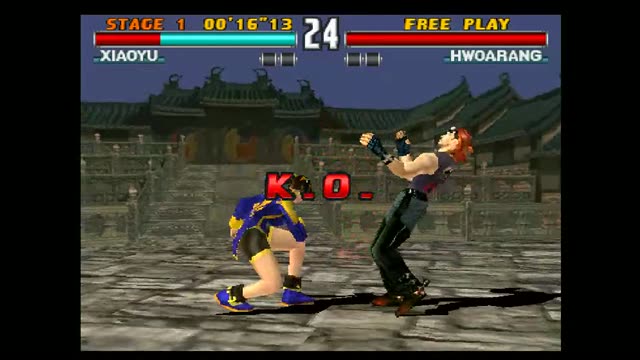

Dead or Alive is a 1996 fighting game developed and published by Tecmo for arcades. Built on the Sega Model 2 hardware, it was released first in arcades in 1996, followed by home ports for the Sega Saturn in Japan during 1997, and for the PlayStation in all regions during 1998.
The Story Behind Dead or Alive
The Japanese release was originally set for December, but the developers finished the conversion ahead of schedule and it was released on October 10. The original game, which runs on the Sega Model 2 arcade board, the same arcade board that Virtua Fighter 2 ran on, had polygonal modeled backgrounds. Some staff members had worked on Tecmo's first fighting game, Tōkidenshō Angel Eyes, and are credited for both games.
When ported to the Saturn, the developers used Gouraud shading (a feature not available on Model 2) for the character models to compensate for the Saturn not being able to generate as many polygons as the Model 2 hardware. Also in 1998, Tecmo released for the arcades in Japan an upgrade titled Dead or Alive++, which was based on the PlayStation version with slightly updated gameplay that was later expanded for the sequel, Dead or Alive 2. The Saturn conversion uses bitmaps and parallax scrolling in the same fashion as the Saturn version of Virtua Fighter 2.
How Dead or Alive Plays
Dead or Alive was well-praised for its fighting system and advanced graphics. The game was followed by its first sequel, Dead or Alive 2 in 1999. Dead or Alive was a commercial success, helping Tecmo overcome their financial problems and turn the series into a franchise, including several sequels and numerous spin-offs.
There are two kinds of holds, an Offensive Hold and a Defensive Hold; the latter are executed by holding back or forward on the directional pad along with the guard input to either force away or counter-damage an opponent. Developed by Tecmo's in-house Team Ninja (known as Tecmo Creative #3 at the time), led by Tomonobu Itagaki, Dead or Alive capitalized on the success of Sega's Virtua Fighter series at the time and takes influence from it while adding unique gameplay elements of its own. Kasumi eventually defeats and kills Raidou, but her decision to leave her village without permission violates the strict laws of the ninja society and is punishable by death.
Why Players Still Load It Up
Sega Saturn Magazine described Dead or Alive as "An incredible beat 'em up both technically and visually, even getting close to beating Sega's own-brand VF [Virtua Fighter] games." Computer and Video Games called it "an essential buy for import Saturn gamers", while Next Generation commented, "Dead or Alive is such a polished game that it's surprising to realize this is Tecmo's first 3D fighter." GamePro lauded it for its vast number of moves and throws, and its fast and intense fights. The PlayStation version would come in 3rd place during week 11 in 1998, selling over 59,000 copies during its first week and would sell over 74,000 copies. Dead or Alive boasts smooth control, crisp polygonal graphics, and an attitude that may enable this game to stand on its own despite its familiar origins." He identified the variety of characters and the danger zones as the game's standout features, and said the tough AI forces players to learn more complex moves and strategies.
Upon the game's release in arcades, a Next Generation reviewer commented, "A fighting game that mimics Virtua Fighter 2 in its look and feel to a frightening degree ... After a loss of 5.2 million dollars (490 million yen) in 1995, Dead or Alive helped Tecmo pull in a profit of 9.2 million dollars (970 million yen) in 1996, saving the company from bankruptcy. Next Generation said this mechanic adds a unique tone to the game and blurs the line between offense and defense during fights, replacing the usual fighting game scenario of one character attacking and the other defending with more of a "push-and-pull" struggle for dominance.
Dead or Alive — Frequently Asked Questions
Who developed Dead or Alive?
Dead or Alive was developed by its developer and published by its publisher.
Where can I buy the original Dead or Alive?
Scroll to "Other Places You Can Get This Game" beneath the write-up — it lists trusted stores selling official copies.
What console was Dead or Alive released on?
Dead or Alive was released for the Sony PlayStation in .
Can I save my progress in Dead or Alive?
It does — with a free account you can snapshot the game at any point using save states, then pick it up later from exactly that spot.
This Game is Also Known As: “dead or alive game”, “dead or alive online”, “dead or alive tournament”, “dead or alive game online”, “play dead or alive free”