Play Monkey Ball Online Free for Sega NAOMI.
That clip up top is the real Monkey Ball — the actual 2001 Sega NAOMI game from SEGA. Grab the free RetroPlayers.Club Player and it runs full-speed on your PC, no cartridge required.
Monkey Ball
Play this Game The Right Way Now -> Download Our Mini App & Start PlayingThe RetroPlayers.Club Player is a Premium perk. Go Premium or sign in to play Monkey Ball at full speed on your own PC.
Monkey Ball can be relived on your own PC through the free RetroPlayers.Club Player app — full speed, with a controller and saves just like your hardware. You confirm you own the game from your library, and no need to connect your console.
🎮 USB or Bluetooth controller? Plug it in, Once Detected Click Here to Open Your Controller Options
| Action | Keyboard | Controller |
|---|---|---|
| D-Pad Up | ↑ | D-Pad up |
| D-Pad Down | ↓ | D-Pad down |
| D-Pad Left | ← | D-Pad left |
| D-Pad Right | → | D-Pad right |
| B (bottom) | X | Bottom face |
| A (right) | Z | Right face |
| Y (left) | S | Left face |
| X (top) | A | Top face |
| L | Q | Left shoulder |
| R | E | Right shoulder |
| Start | Enter | Start |
| Select | V | Select |
🎮 Sega NAOMI controls
These are the keys the RetroPlayers.Club Player app uses for Sega NAOMI, shown for reference. Your controller still lights up below so you can confirm it is detected — Premium members can remap here (keyboard or USB controller) and the app applies the map at the next launch.
No controller detected yet — plug one in and press any button.
Press buttons — your controller lights up here so you can see it is detected. Go Premium to save a custom map.
| Action | Keyboard | Controller |
|---|---|---|
| Tilt Up | W | D-Pad up |
| Tilt Down | S | D-Pad down |
| Tilt Left | A | D-Pad left |
| Tilt Right | D | D-Pad right |
| Start | Enter | Start |
Report this game not working
First registered run claims the top spot. It won't stay easy for long.
Playing counts once you're signed in — register free in the player above.

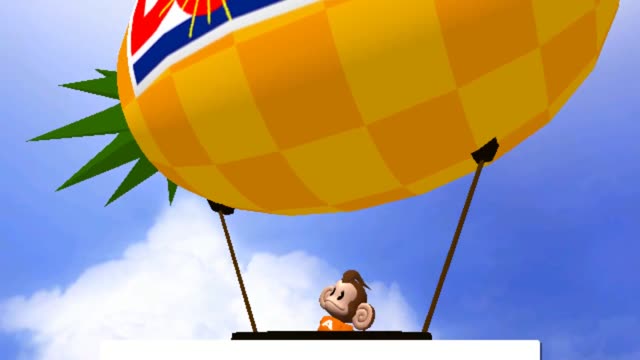
Due to the discontinuation of Sega's Dreamcast home console and the company's subsequent restructuring, an enhanced port dubbed Super Monkey Ball was released as a launch title for the GameCube in late 2001, garnering interest as Sega's first game published for a Nintendo home console. Super Monkey Ball is a 2001 video game developed by Amusement Vision and published by Sega.
How to Play Monkey Ball
The RetroPlayers.Club Player ships with Monkey Ball already mapped — the layout below is the default, and Controller Mapping in the app rebinds any of it.
The Story Behind Monkey Ball
SEGA released Monkey Ball for the Sega NAOMI in 2001.
A theme song called "Ei Ei Puh!", which was arranged by Cheru Watanabe and featured vocals by Yu Abiru, was created for the Japanese version of Super Monkey Ball but removed from its U.S. release. Intended to feature a "cute" aesthetic and accurate physics engine, the game debuted at the 2001 Amusement Operator Union trade show as Monkey Ball, a single-player arcade cabinet controlled with a distinctive banana-shaped analog stick. Tokyo-based voice actor Brian Matt provided the game's narration, albeit uncredited.
Although Monkey Ball had been developed for Sega's NAOMI arcade board, which shared technology with the Dreamcast and was optimized to ensure games could be easily ported between the two platforms, Nagoshi commented that Nintendo's young demographic made the GameCube an even more fitting console for the title. Super Monkey Ball was developed by Amusement Vision, a branch of the Japanese video game publisher Sega that was created in 2000 and composed of about fifty people. Prototypes involving a plain ball or a ball with an illustration were considered visually unappealing due to difficulties in perceiving its movement, so after a series of revisions monkey characters previously created by an Amusement Vision designer named Mika Kojima were placed inside the ball, with their appearance being altered to include their "distinctive" ears.
What You'll Play
Monkey Ball is a action game for 1 player, played full-speed in the free RetroPlayers.Club Player with its Controller Mapping panel.
If the ball falls off a floor (an event dubbed a fall out) or the in-game timer reaches zero, the player loses one of their three lives. The main game features three difficulty levels—Beginner, Advanced, and Expert, consisting of 10, 30, and 50 floors each—as well as three modes—Normal, Practice, and Competition. Super Monkey Ball received highly positive reviews from critics, who praised the simplicity and subtle depth of its control scheme as well as the new multiplayer modes not present in its arcade counterpart, although some felt its presentation was lacking.
Pausing the game and selecting the "View Stage" option allows one to rotate the camera around and examine the floor. The game's North American sales were strong in 2001, in addition to a further 105,000 units sold through August 2002.
Why It Still Hits
Monkey Ball reached Sega NAOMI players in 2001 as a action game, and the reviews and rankings below are what it is still loaded up for.
Super Monkey Ball received "generally favorable" reviews, with aggregated scores of 87/100 on Metacritic and 88.7% on GameRankings, some journalists considered Super Monkey Ball the highlight of the GameCube's launch lineup. If that experience could be distilled into a single word, it would be euphoria; reducing Super Monkey Ball to one word is simpler. Kent (The Japan Times) described the game as "a test of nerve" requiring "advanced eye–hand coordination." Turner reflected on the game's ability to evoke feelings of "nervous excitement", "intensity", and "electrifying, stomach-wrenching fear": "It's a thrilling feeling to be winding down a paper-thin path with ten seconds on the clock, hoping against hope that you can keep your balance for just a few more seconds and make it to the goal before time expires." Edge opined that the game is "defined" by "unrefined and angular" emotions: Every second brings another jagged spike of highrise elation or freefall despair, and that's what makes the game so superb ... when you finally beat a maze on your 15th try, on the last life of your last continue, it's all worth it.
Edge praised the main game as "absorb[ing]" due to its high level of difficulty, noting that the trial and error required to complete challenging levels forces one to learn the nuances of its "reductive control system" and eventually enables the player to perform seemingly impossible tasks with increasing ease: "Once a level falls, the mysticism around it vanishes. On the party and mini games, Kent asserted "All of the activities ... were designed with an unerring eye for quality", Edge contended "none are half-assed throwaway rewards", and Nintendo Power remarked "each one is a fully realized activity that you could play for hours." Ricardo Torres (GameSpot) called Monkey Race "a solid little racer", and Casamassina recounted it felt "polished and finely tuned." Stevenson "loved Monkey Fight", while Casamassina and Kent highlighted the use of a crown to identify the player currently in the lead as encouraging "players to gang up on each other." Casamassina hailed Monkey Fight as "a thing of beauty", but Turner dismissed it as "a dud, as it's too much frantic button smacking and not enough skill or thought." Monkey Target, lauded by Kent as the "most addictive interactive activity of 2001" and considered "the most complex" of the party games by Turner, was complimented by Casamassina for its "simple and brilliantly intuitive" control scheme and "careful science of when to use an item and when to forgo it." Nintendo Power and Medina, respectively, described Monkey Billiards as "a full-blown pool game" and "a very fun alternative to the real game"; Casamassina applauded its "ultra-realistic physics engine that perfectly mimics how pool balls would react ... it all works just as good if not better than any pool simulation available to home consoles." Casamassina was further impressed by the physics of Monkey Bowling, elaborating that "when the pins break apart one would swear it's the real deal", but Turner criticized its physics as "slightly wonky". Edge likened the game's aesthetic to Sega's Sonic the Hedgehog series: "Every surface is bright and solid and shiny, every aspect impeccably presented." Casamassina, Turner, and Torres all praised the consistent frame rate, with Casamassina emphasizing "it truly, always runs at a full 60 frames per second." However, Four-Eyed Dragon noted the visuals were "not greatly detailed" and Casamassina observed "there isn't much geometry being drawn at any single point in the title and the backgrounds are often barren, whether it be for power or stylistic purposes." Moreover, Casamassina was disappointed that the three difficulty modes reused level themes and by the absence of progressive scan support.
Background sources: Wikipedia.
Monkey Ball — Frequently Asked Questions
Can I save my progress in Monkey Ball?
Yes, with Premium: the app lets you save a state at any point in Monkey Ball and resume from exactly there.
Do I need to download anything to play Monkey Ball?
Monkey Ball plays through the free RetroPlayers.Club Player app rather than in the browser, because the Sega NAOMI needs the full power of your desktop. The preview above shows the actual game running.
Can I remap the controls in Monkey Ball?
Yes. The RetroPlayers.Club Player includes full controller mapping — open Controller Mapping in the app to rebind any key or gamepad button for Monkey Ball.
This Game is Also Known As: “monkey ball game”, “monkey ball online”, “monkey ball play online”, “monkey ball game online”, “play monkey ball online”